
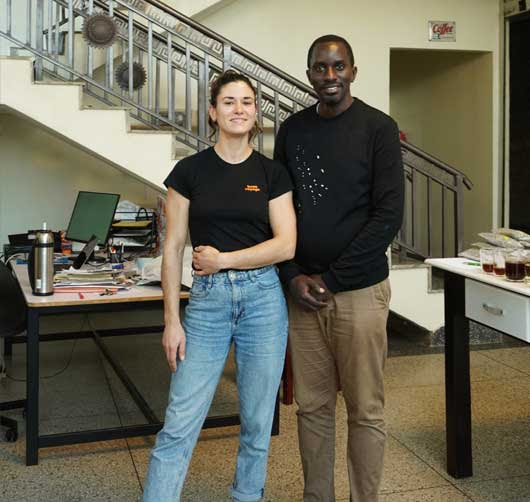
Over 8 years ago, I left Mbeya in Tanzania, which I had called home for 2.5 years, to move to the UK and start a new adventure with Falcon. I hadn’t been back to East Africa until a few weeks ago. 8 years!
As soon as I landed, I couldn’t help but notice all the similarities between Tanzania and Uganda. And there are many! Even though Uganda also surprised me in many ways. I knew this would be a special trip, but I didn’t expect to feel emotional and filled with cherished memories as I was holding a Stoney Tangawizi (basically a ginger beer/soda), watching a beautiful sunset over the mountains (African sunsets are hard to beat) or listening from my bed to music played somewhere outside, until late at night, every. single. night. Yes, even that made me smile. A beautiful journey down memory lane.
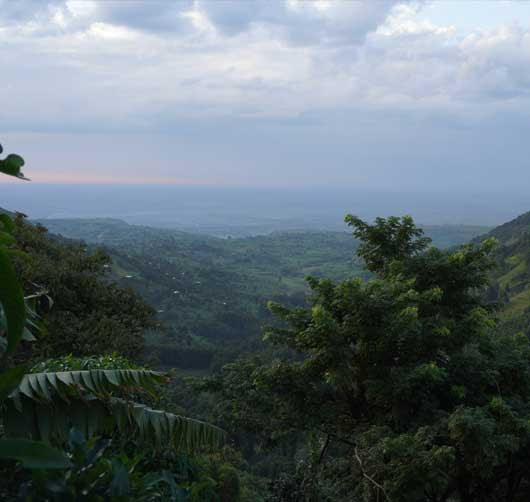
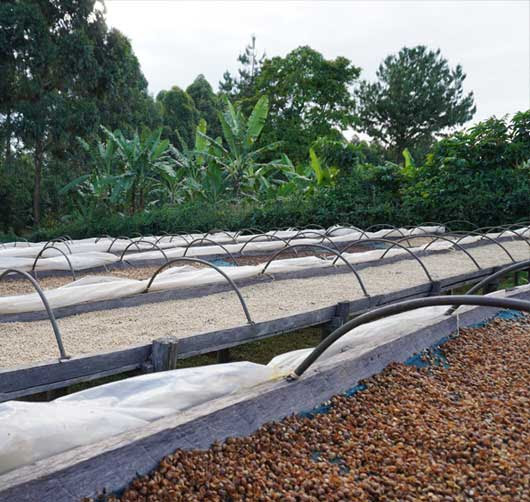
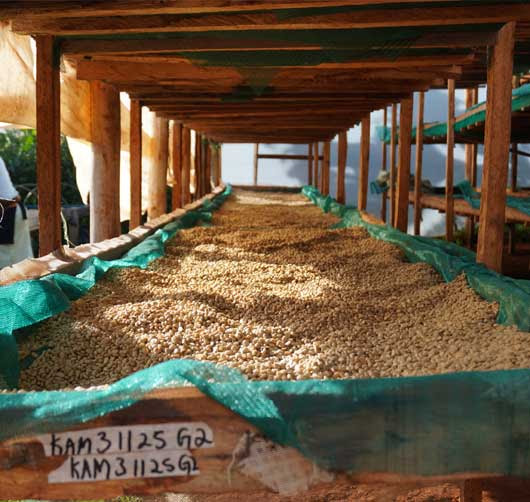

I had also missed the effervescence and the urgency of the harvest here. It’s a rush. It’s a race. A race for cash, a race against the rain, a race for quality and volume to make sure it’s a successful one. It’s only a few weeks of buying. You can’t afford to get it too wrong. And every day, there are new obstacles. Today, the washing station called, they were not getting many cherries because the runners couldn’t reach the station. It had rained quite a bit up on the mountain and the slopes we had carefully walked down the day before (which they were running down with 40-60 kg of cherries on their heads), were very slippery. Runners were falling. It’s as simple as that. The business can be completely put on hold because it’s raining too much. Not something we would even think about in Europe.
On Sunday afternoon we cupped in the lab. The Coffee Gardens cups in big glasses that look like whisky glasses. When we finished the cupping, we wanted to clean up, but were stopped by Donald the lab manager who told us, “These glasses don’t stack or they break, so we need to be careful.” I asked, “Why use such big glasses (which means using a lot of coffee and a lot of drinking water) that don’t even stack? They also get very hot and are hard to handle.” Donald explained, “These are the only ones we could find that have all the same volume and don’t break with hot water.” Of course. I caught myself there. I was taking things for granted, once again. Difficult habit to lose when you live in Europe.
So, every day you are on alert. What could happen today? What crazy creative ways could I find to solve these issues? It’s not for everyone, but I find it extremely stimulating and it gives me a huge sense of purpose which is motivating!
It’s also been great being back in the field. To go to the buying station, we had to hike for about 2 hours. It’s lush, one of the lushest places I have ever encountered. There are many waterfalls, hundreds of kids going to school and a different bird singing at every bend in the way. I step onto the farm and chat to the farmers. This is my happy place. I reflect on how privileged we are to be able to do all of this.
It has been an interesting time for me as I haven’t been to the field since prices peaked. This changes the tone of the chats and the dynamic in the field. Prices have been on a record high for the last two seasons. Two years ago, 1 kilo of cherries was sold for around 2,800 UGX. This year it sells for around 3,500 (which is exactly $1 at the exchange rate when I travelled). To make a kilo of exportable green for specialty (0 primary defect, max 5 secondary), you need 7 kilos of cherries in this supply chain. So, you essentially pay a green equivalent of $7 / kg to the producers. That is the cost of coffee before the cherries are even transported to the washing station. I don’t think I need to say much more if you wonder why coffees are expensive back in Europe.
This has however made a massive improvement for farmers who will be able to invest in their farms, plant new trees and improve their way of life. Many people are considering getting into coffee now. I know this high market is difficult to navigate and a lot of people are struggling, but I’m going to be honest; I never thought farmers in East Africa would get $7 / kg (equivalent of exportable green), and that makes me VERY happy.
Such a market is very tricky for exporters too, as the amount of financing needed to be able to buy the right volume and quality at the right time has increased a lot. Shak said to me, “I would like to stop focusing on the money and actually put my heart into the coffee.” After speaking to a few people that week, I realised how much everyone has to adopt the role of ‘bankers’ and how much they wish they could be a bit more ‘just coffee’ people. The financing component of the roles of exporters and importers is crucial. Commitment from roasters, this year, translates directly into available cash and financial safety, like it never has before in the coffee industry.
Being here in Uganda and working with the The Coffee Gardens team; Shak, Dana, Donald, Misa, Job, Winnie, Jackie, Rachel, Sam, Ivan and Mudondo, has really felt like working as a team. And it’s such a nice feeling that we can be ourselves with suppliers, and vice versa. There is a huge level of trust involved, and a genuine care for each other, and the desire to grow together for all the businesses involved.
Line Cosmidis is Head of Specialty Sales at Falcon . She has an engineering degree in agronomy and her path in the coffee industry began in Venezuela, Peru and then Tanzania, where she applied her studies and experience in agronomy and farmer impact projects alongside sales and logistics-based tasks. Line works with the sales team and provides support for our roaster clients across Europe.