
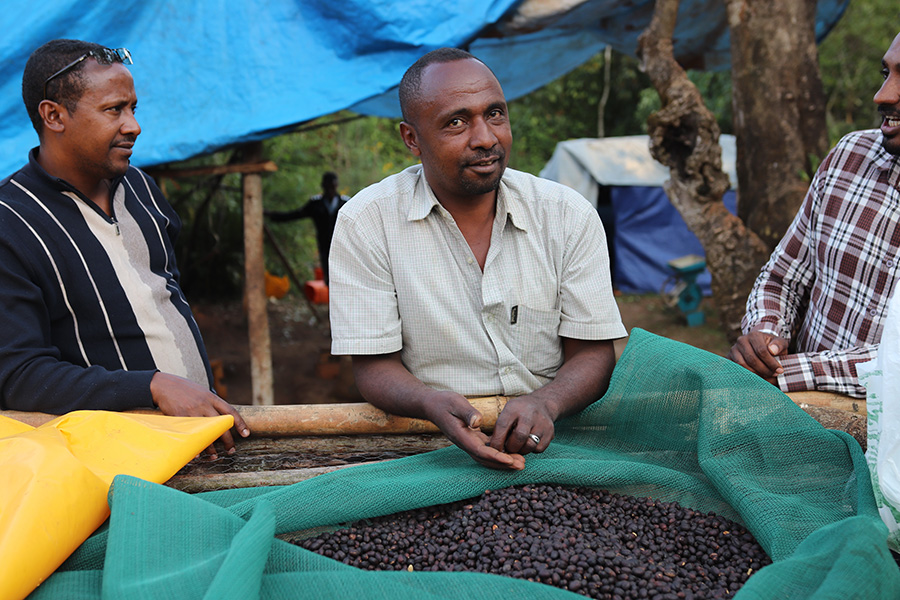
This project supports one of our key producers in southwestern Ethiopia, Mustefa Abakeno, to enhance the quality of the coffees produced at the five washing stations he now owns and manages.
Origin: Djimmah, Ethiopia
Timeline: Commenced at the beginning of the 2020–21 harvest
Project Status: Active in 2024/25
Budget: $5850 per year
2024 HIGHLIGHTS
• In the five washing stations managed by Mustefa Abakeno – Bedeyi, Echimo, Jarso, Kebira, and Sedi – the out-grower group contributing coffee increased to 228 members, comprising 216 men and 12 women.
• A dedicated warehouse and hulling machine were constructed in the town of Agaro to store, process, hull, and provide services to specialty producers and exporters in the area.
THE OPPORTUNITY
This initiative supports Mustefa Abakeno, one of Falcon’s key producers in Ethiopia, improve the quality and consistency of the coffee produced at his washing stations, and to ensure high-quality standards for the coffee he manages.
Mustefa, 52 and a father of eight children, is a smallholder farmer with 18 hectares in Beshasha Kebele, a village in the Djimmah zone of Oromia. He played a pivotal role in founding the Hundaoli PC and Kata Muduga Unions in the area. In 2021, we recognised that Mustefa’s coffee had great potential, achieving high-quality cup scores at the pre-shipment stages, but quality tended to degrade post-export. With assistance from our field agronomist, Harun Siraj, we identified key areas in both pre- and post-harvest stages that could improve overall cupping quality, with a particular focus on retaining quality after export.
Mustefa was an early adopter of good agricultural practices (GAP), such as pruning, stumping, and using waste from wet-processed coffee pulp as compost, as well as using by-products from hulled coffee as mulch and organic fertiliser. These practices are now used on his own farm and by his out-growers.
Harun has also supported Mustefa with sustainability initiatives in coffee production, including leading certification processes and gathering data for the upcoming EU Deforestation Regulation.Mustefa is also diversifying his farm by planting new banana varieties on a five hectare demo plot for other farmers in the area. Additionally, he produces high-quality honey, which generates extra income.
THE PLAN
During the off-season, Harun assists Mustefa and local growers with data collection, yield estimation, and implementing key plant management, including pruning, stumping, shade management, raising seedlings of selected varieties, and soil and water conservation.
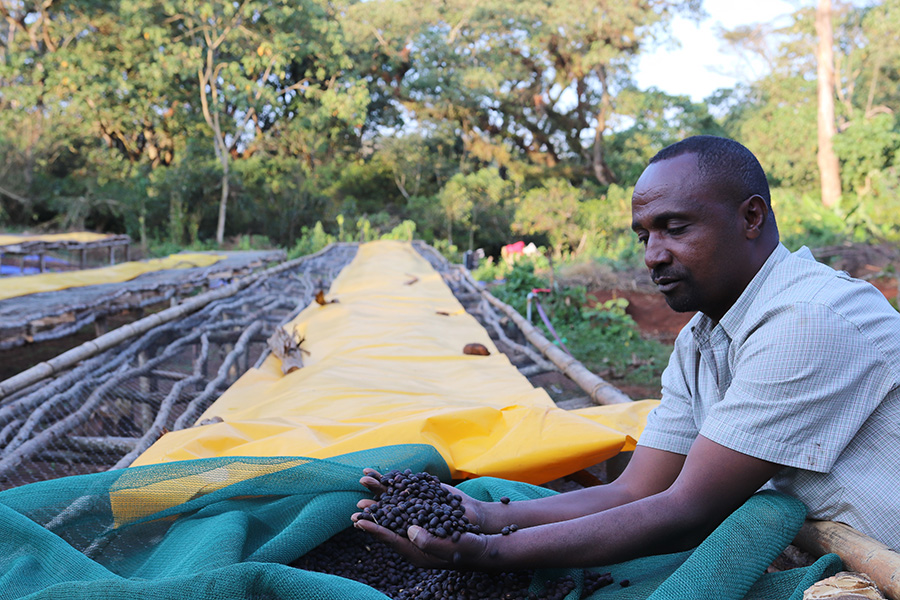
An important achievement this year was the purchase and installation of shade netting to cover and protect the coffee parchment during the hottest periods, which promotes slower, more even drying. Mustefa has also experimented with slow drying under shade, with promising results. Falcon’s Quality team shares overall cupping results with Mustefa and Harun at the end of each season. From this feedback, Harun identifies issues, and together, they work to determine the root causes and implement corrective actions for the next batch. Intervention strategies are developed and applied across Mustefa’s entire value chain to improve coffee quality and services.
At the post-harvest stage, Harun regularly visits farmers to evaluate the health of their plants, offer agronomic advice, and support the distribution of coffee seedlings to encourage farm renewal.In the era of transparency, field officers carefully keep each coffee lot separate. Each day, lots are tagged with details such as volume, processing time, date on the bed, and moisture content. The coffee is only moved into storage once it reaches the acceptable range, significantly improving the consistency of the coffee’s quality. Harun has focused on gathering and organising information across Mustefa’s coffee value chain to ensure transparency and traceability.
THE RESULTS
The overall quality of Mustefa’s coffee for the 2024–2025 season has improved since the changes started in 2021. The coffees no longer show signs of early ageing and have significantly improved in flavour and texture, thanks to increased care during the post-harvest phases.
In 2024, Mustefa expanded his out-grower membership to 228 partner farmers – 216 male and 12 female – across five locations: Bedeyi, Echimo, Jarso, Kebira, and Sedi. This represents a nearly sixfold increase from last year, largely due to Mustefa’s inclusive business model. Many farmers joined after seeing the success and satisfaction of existing members. In terms of volume, Mustefa increased his export volume by 60% compared to the previous season.
Harun’s partnership with Mustefa remains strong, and together, they continue to uphold high standards of quality coffee. This ongoing collaboration is expected to lead to better prices and further strengthen Mustefa’s reputation as one of Ethiopia’s top producers of specialty coffee.